
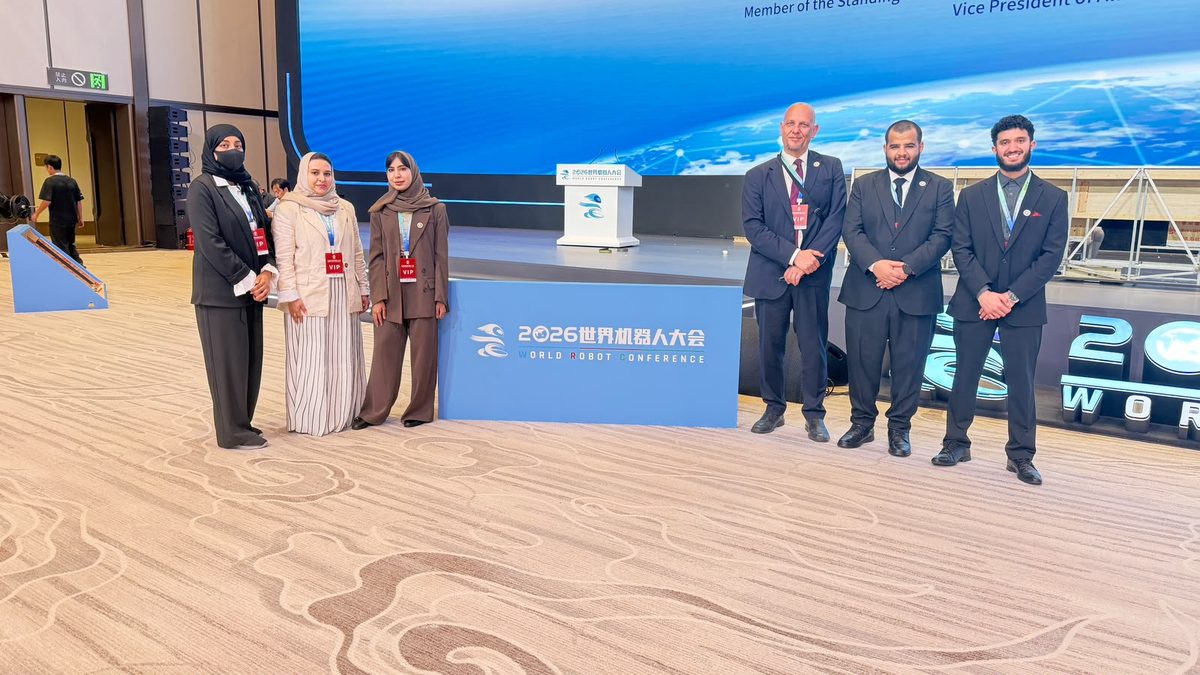
The author attended the World Robot Conference 2026 as a private sector delegate on the Artificial Intelligence Association’s national capability-building programme for physical AI. Views are his own.
On the morning the World Robot Conference opened in Beijing, Unitree Robotics listed on Shanghai’s STAR Market. By the close its shares had risen roughly 460 per cent, valuing a company that sells a $1,600 robot dog at about $50 billion. It had touched $66 billion at the opening bell and given a third of that back before the session ended. A few kilometres away, in the exhibition halls of Yizhuang, its humanoids were boxing in front of a crowd ten rows deep. I was in that crowd.
I went as a private sector delegate, which is a particular way of walking a hall. I spend my working life pricing and distributing physical product into the Gulf. I was there to work out what any of it costs to own.
The number everyone repeated was that Chinese makers accounted for about 97 per cent of global humanoid shipments in the first half of 2026. That comes from Smart Analytics Global, is corroborated by ABI Research on a different measure, and is probably right. The number announced at the conference, that China alone shipped more than 40,000 humanoids in the same period, is probably not. Independent trackers put the entire global market at 19,000 to 22,000 units, and Counterpoint’s vendor-level count of the five largest Chinese makers reaches under 20,000. Morgan Stanley’s full-year forecast for China is 50,000, up from 28,000 in January, its second upgrade of the year. For 40,000 to be a half-year figure, shipments would have to collapse in the second half of a boom. I wrote the 97 per cent down. I left the 40,000 where I found it.
The show behind the show
The demonstrations are what travel on social media: robots boxing, dancing, playing table tennis, taking penalty kicks against schoolchildren. They are real and they are fun. They are also the least interesting thing in the building.
The story is that the industry has moved from proving robots can move to proving robots can work, and that the machines winning that argument are the plainest ones in the hall. In August, X Square Robot ran a livestream in which a six-axis arm station driven by its WALL-B model sorted 1,816 parcels an hour at better than 98 per cent accuracy. The mark it was aimed at was the 1,248 an hour that Figure AI’s bipedal Figure 03 averaged across a 200-hour run at its California headquarters in May. These are not the same test, and both figures come from the companies that benefit from them. The argument survives anyway, and X Square’s Yang Li put it to the South China Morning Post at the conference: if wheels get the job done, why pay for legs? Buyers walking the halls this year asked about payload, uptime and price per task. Not backflips.
That scepticism had a written counterpart. HSBC told clients in July that the shipment surge “could be illusionary”, and that without a significant improvement in robot makers’ AI models the current upcycle is unlikely to hold for another one to two years.
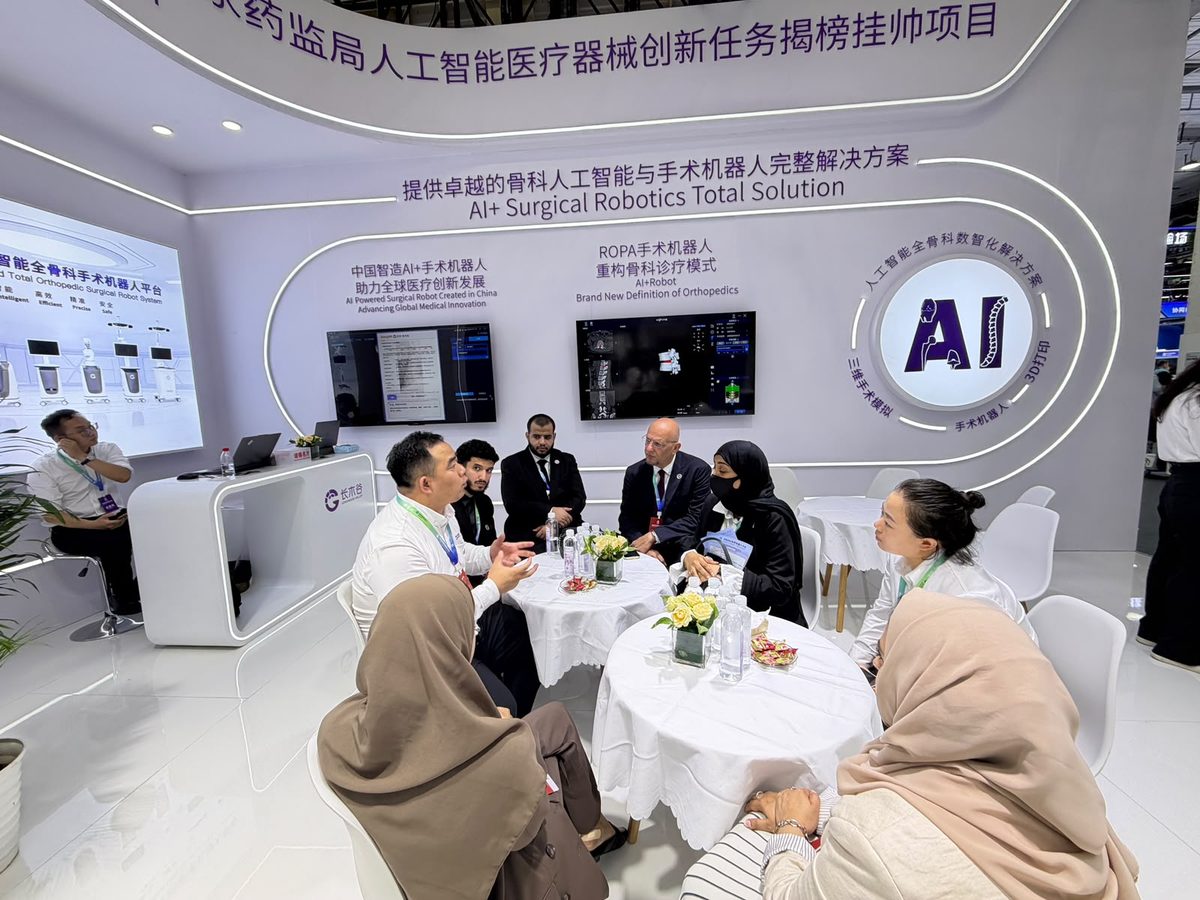
The order books are real, but older and narrower than the conference mood implied. UBTECH disclosed in November 2025 that its Walker series had accumulated more than 800 million yuan in orders, with BYD, Geely, Dongfeng Liuzhou and Foxconn among the customers. Galbot won a 236 million yuan procurement in June, the largest disclosed embodied-AI order in China this year, from a Yibin state-owned energy joint venture rather than from a carmaker, and separately has had its S1 working CATL’s production lines at Ningde since March. The sector has crossed from slideware into invoices. Volume is the next crossing, and it comes later.
Inside the factories
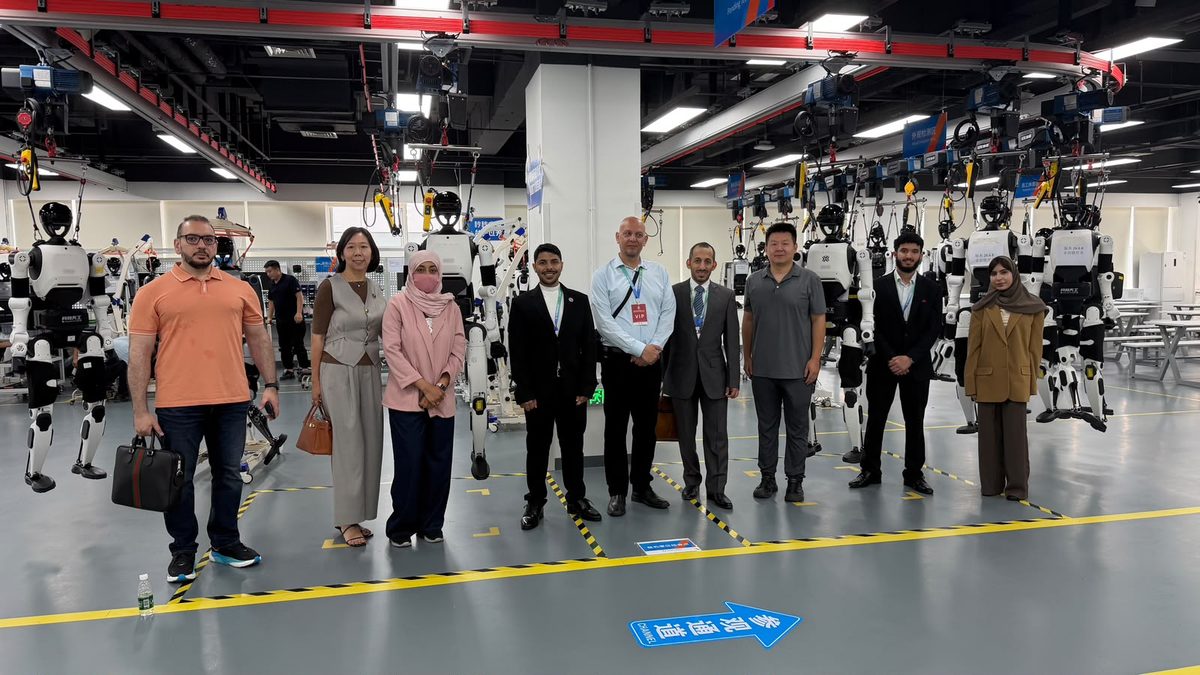
At the Beijing Innovation Center of Humanoid Robotics, known as X-Humanoid, we walked the line where humanoid robots are developed, assembled and tested. This is the institution whose Tiangong platform runs on state backing from Beijing’s municipal government and the Ministry of Industry and Information Technology. Watching engineers tune a torso in a harness, a metre away, strips the mystique off the product category. It is manufacturing. Precise, repetitive, auditable manufacturing.
The presentation was about the company and its products, and I asked the technical lead directly what wears out. The joints. They take most of the beating, and they are the part that needs replacing.
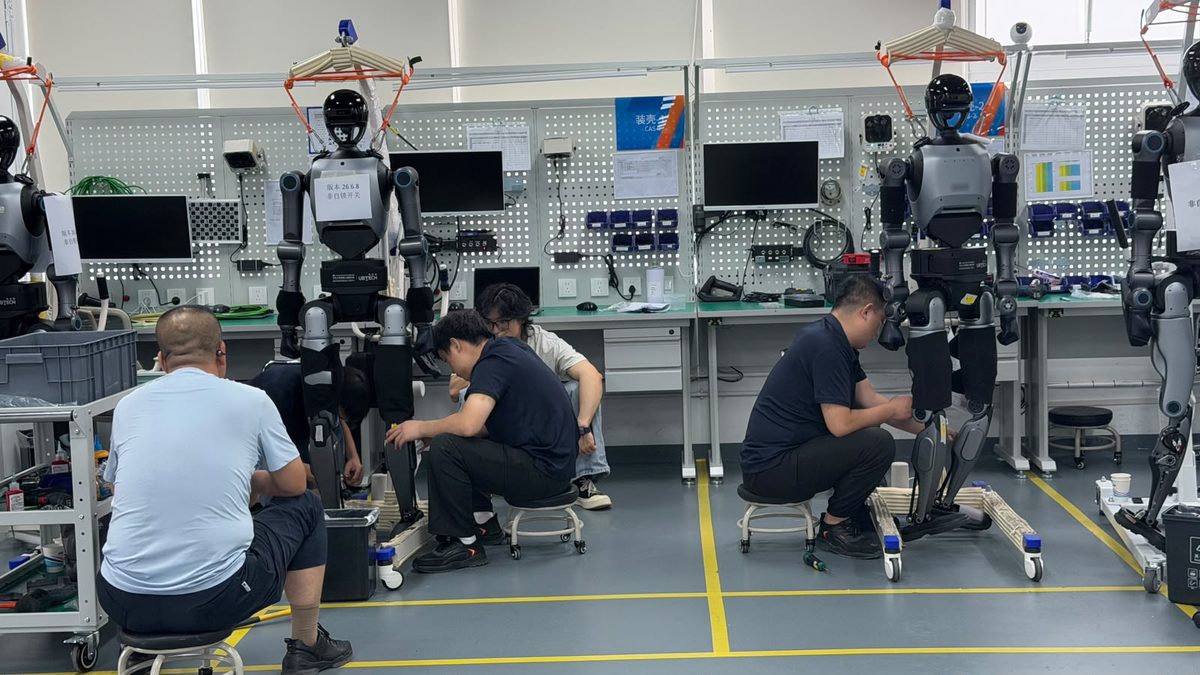
At Leju Robotics we saw something I had not fully appreciated before the trip: a data training centre, more than 10,000 square metres and the largest of its kind in China, where fleets of humanoids rehearse household and industrial tasks across sixteen built scenarios, from a car assembly line to an elder-care room. One robot generates roughly four hours of training data a day. The robots are both the product and the instrument that improves the product. Whoever owns the training data compounds.
We also sat with institutions most trade visitors never see: the Beijing Institute of Artificial Intelligence at Beijing University of Technology, the Beijing Arbitration Commission, which also sits as the Beijing International Arbitration Court and hears technology disputes, the China Society of Automotive Engineers, and the Chinese Association for Artificial Intelligence. A pattern held across every meeting. Cities and provinces now run more than a dozen government-backed embodied-AI innovation centres, two of them designated national-local joint centres in Beijing and Shanghai. Precision reducers, the harmonic drives and RV gearboxes that Japan’s Harmonic Drive Systems and Nabtesco once controlled, are now majority-supplied domestically: Chinese makers took about 61 per cent of China’s RV reducer market by unit in 2024, against 42 per cent in 2022. The state is building an ecosystem, layer by layer.
The Kingdom on the programme
Two papers by Saudi women researchers were presented at the WRC Symposium on Advanced Robotics and Automation, the conference’s IEEE-indexed academic programme, one on a multi-agent service robot for live events, one on a trustworthy government-services robot. A Saudi chief executive spoke on the conference panel about cross-border compliance for robotics companies going global. Our delegation met the Saudi Cultural Attaché in Beijing to connect the Kingdom’s training pipeline to Chinese institutions.

The Kingdom’s AI story is usually told as procurement: what we buy, what we host. In Beijing I watched it told as participation: what we present, whom we train, where we sit on the panel.
What I brought home
Asked what I made of the conference, I reflected a bit and said the focus here is on humanoids, which I feel are not ready for full industrial deployment. I said it may require five years. I said the sectors that are commercially viable are hospitality, health care and logistics.
I am impressed with the humanoid robots’ balance and their ability to walk and do some action sequences. But the delay in reaction, the slowness in performing some tasks, and the amount of training still required to become autonomous is large.
Three conclusions, held with different confidence.
First, and I hold this one firmly, the commercially viable sectors are hospitality, health care and logistics, and most of what serves them is not humanoid. Hospitality means hotel, cleaning and service robots. Health care means robotic arms. Logistics means a mix, and I do not know how much of that mix is humanoid yet; I will leave that to the industry’s proven numbers. These have reference customers, spare-parts networks and unit economics a distributor can model.
The humanoid layer is not there. Five years is my own estimate for full industrial deployment, and it is a judgement rather than a forecast anyone handed me.
Second, held loosely, the window for Gulf partnerships is narrower than it looks from here. Chinese vendors are appointing regional channels now, while the GCC precedents are thinner than the headlines suggest: one humanoid showroom in Riyadh, opened last November, and construction-robotics ventures committed at NEOM that have yet to put a robot to work. Being first into a channel and being third are different businesses, and I have an interest in saying so.
Third, capability transfer beats product import. The most valuable thing China showed us was the machinery around the robot: the innovation centres, the data-training floors, the component localisation, the dispute-resolution infrastructure.
I flew back to Riyadh with one image that stays with me: a hall of half-built humanoids hanging in their harnesses, patient as suits on a rack, waiting for software. The hardware race is being won in front of everyone. The software race is still open.
Selected sources: WRC 2026 closing statistics from the organiser’s release, 24 Aug 2026 (organiser figures). Unitree listing: SCMP, Bloomberg and TechNode, 19 Aug 2026; TechTimes, 21 Aug 2026. Shipment share: Smart Analytics Global via Bloomberg, 10 Aug 2026; Counterpoint Research, 19 Aug 2026. China half-year shipment claim: China Humanoid Robotics and Embodied Intelligence Committee of 100, released at the conference, 20 Aug 2026. Morgan Stanley forecast: SCMP and CNBC, 24 Jun 2026. HSBC note quoted in Fortune, 19 Aug 2026. Parcel sorting: X Square Robot company release, 13 Aug 2026; Figure AI run reported 25 May 2026; SCMP, 23 Aug 2026. UBTECH company release, 17 Nov 2025. Galbot procurement award reported 29 Jun 2026; CATL company announcement, Jun 2026. Precision reducer share: Chyxx industry research, 2025. Conference analysis: KrASIA, 24 Aug 2026.
Nabil Al-Kilany is Chief Business Development Officer of MHG Trading, listed on Tadawul and trading as Buildstation. He has spent twenty-five years distributing building materials across the Gulf, Spain, China and Türkiye, which is the seat he was sitting in when he wrote this.