
Not long ago a capable colleague sent me a paper that was better written than anything I had seen from them before. The structure was clean, and the analysis ran in the order a consultant would use. I knew the author’s earlier work well, and I knew within a paragraph that a tool had done much of the drafting. Then I asked the question the paper existed to answer, what we would have to give up to get what it recommended, and the paper did not answer it. The tool had lifted the quality of the document. The quality the business needed was not in it, with the tool or without it.
I should declare my own position. I use these tools every week, and the first draft of the research behind this article came from an AI research agent I built; the fact-check found six errors in it before a word of it reached this page. I would not ask anyone to stop using them. The question is what a board should stop assuming.
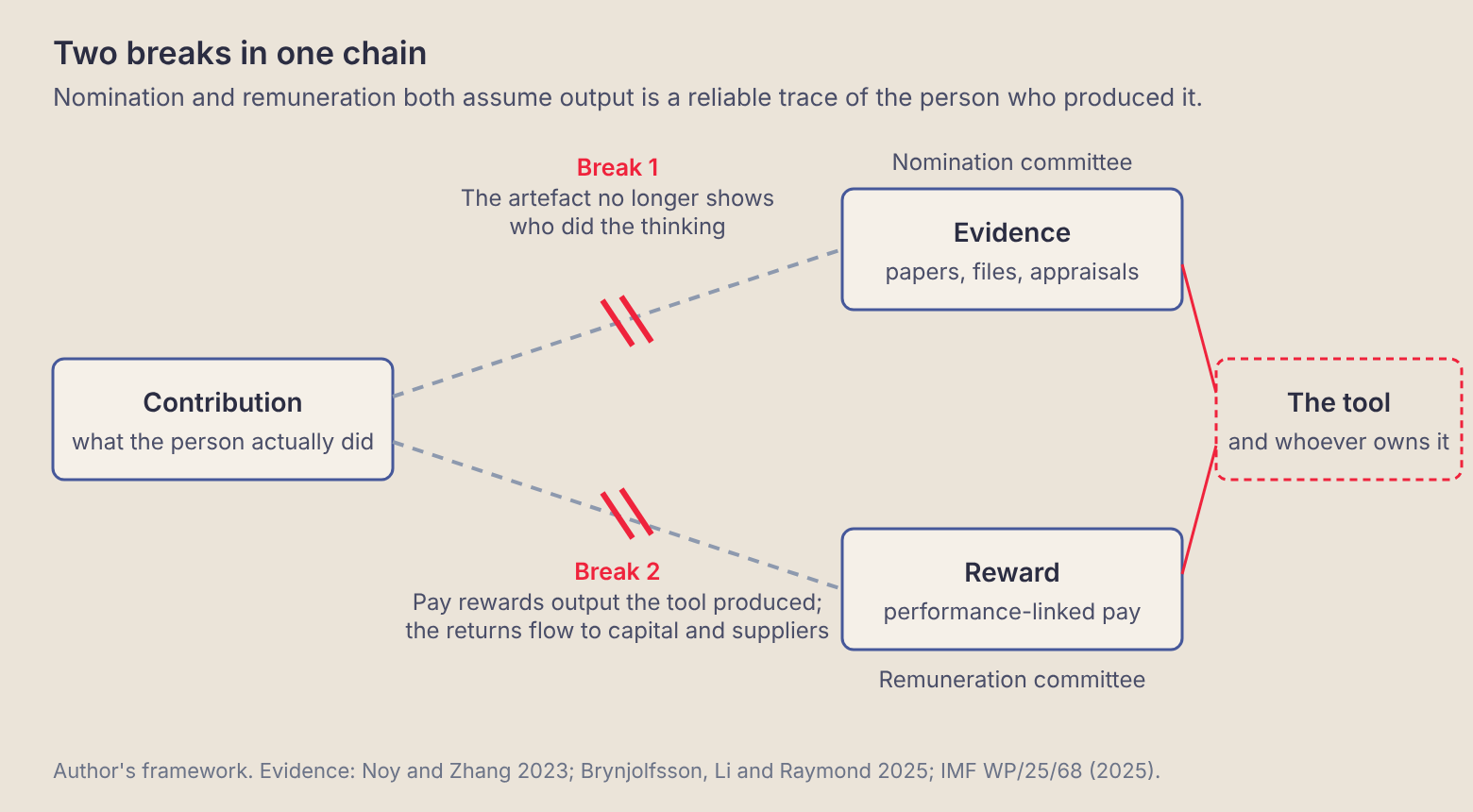
What it can no longer assume is that output is a reliable trace of the person who produced it. Every instrument a board uses on people and pay rests on that assumption somewhere, and AI breaks it twice. The document stops showing who did the thinking, so the nomination committee loses sight of who is good. Part of the improvement belongs to the tool and whoever owns it, so the remuneration committee loses sight of who earned what. I caught that paper because I carried years of the author’s work in my head, and knew the market and the subject it dealt with. A board reading a paper cold has no such baseline.
The artefact stopped being evidence
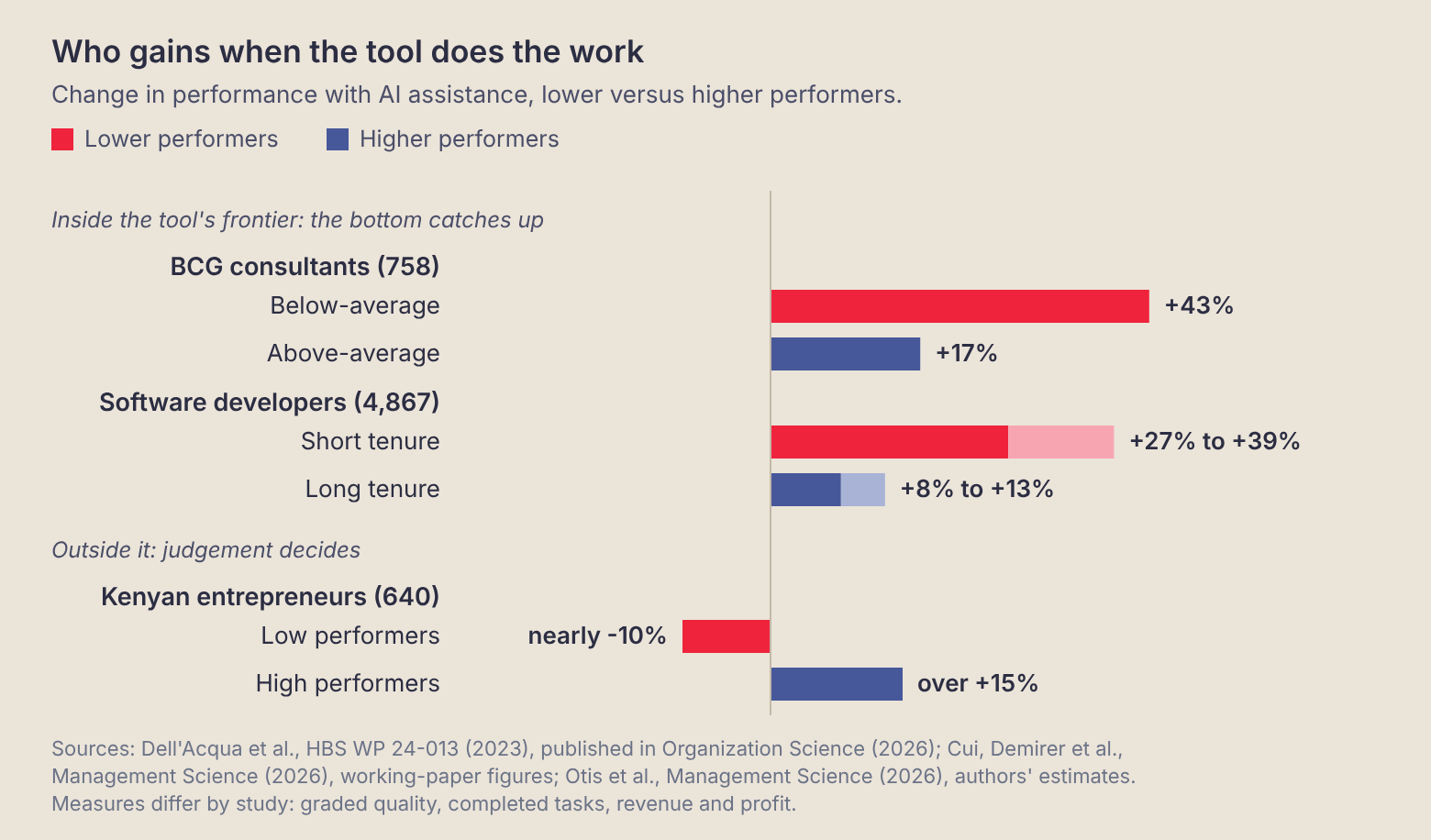
On tasks the tool handles well, the controlled studies agree: it lifts the weakest performers most and narrows the visible gap between them and the best.
Noy and Zhang gave 453 professionals everyday writing tasks and reported in Science in 2023 that ChatGPT cut the time taken by 40% and raised graded quality by 18%. The detail that matters for governance is in their working paper. Without the tool, a worker’s grade on the first task predicted the grade on the second with a correlation of 0.49; with it, 0.25. The first piece of work became a much weaker guide to the next. The strongest writers kept their grades and finished faster, and the weaker ones caught up.
Brynjolfsson, Li and Raymond followed 5,172 customer-support agents and found, in the Quarterly Journal of Economics in 2025, that an AI assistant raised issues resolved per hour by 15% on average. The least skilled gained most; agents two months into the job matched untreated colleagues with more than six. The assistant had been trained on the transcripts of the best agents. It took their tacit skill and handed it to the newest hire, which is excellent for the customer and a problem for anyone trying to identify, from the output, who the best agents are. At Boston Consulting Group, Dell’Acqua and colleagues found the same pattern among 758 consultants: below-average performers gained 43% against 17% for those above average, in the working-paper version of a study now published in Organization Science.
Markets noticed first. In a 2025 preprint not yet peer reviewed, Galdin and Silbert studied 2.7 million applications on Freelancer.com. Once language models arrived, the value employers placed on a tailored application fell by about 42%, and it stopped predicting whether the job would be done. A cover letter used to be costly to write well, which is why it meant something. Nor can readers tell the difference: across six experiments with 4,600 participants, Jakesch, Hancock and Naaman found that people could not distinguish AI-written self-presentations from human ones.
Two caveats. Polish is not always cosmetic; Wiles, Munyikwa and Horton found that a pre-generative writing aid raised hiring by 8% because clearer writing helped employers see ability that was already there. And none of these studies was run in the Gulf or at the top of a company. Carrying them to the executive layer is my inference.
What the tool cannot lift
In every one of these studies the strongest performers stayed at or near the top. What changed is where their difference shows.
Dell’Acqua’s team included a task deliberately built to sit outside the tool’s capability. Without AI, 84.5% of consultants reached the right answer; with it, between 60% and 71% did. The tool produced a confident, well-written, wrong answer, and many good consultants accepted it. Otis and colleagues gave 640 Kenyan entrepreneurs the same AI adviser, in a study published in Management Science in 2026. On the authors’ estimates, high performers gained more than 15% and low performers did nearly 10% worse, and the gap came from which advice they chose to act on.
Once the tool writes the paper, people are told apart by what they accept from it, what they reject, and how they handle the part it gets wrong. The paper on my desk failed exactly there, at the trade-off the tool could not make for its author. The evidence of ability has moved from the artefact to the judgement behind it, and most evaluation machinery is still pointed at the artefact.
Where the board still reads artefacts
Board papers were never single-author evidence, and a good director has always known it. The tool makes that blind spot universal, down to the most junior manager’s first draft. Executive bonuses mostly run on financial results, and a serious chief executive search leans on track record. The exposure sits in three places: the papers a board reads, the appraisal of managers below the executive committee, and the lower layers of the succession file built from that appraisal.
The directorship programme behind this series teaches ten rules for a better board paper. Most concern form, and a current model meets them by default; none asks who did the thinking. The Capital Market Authority’s Corporate Governance Regulations require, in Article 38, information that is “complete, clear, correct and non-misleading.” A paper can satisfy every word and still leave the board unable to tell management’s judgement from the tool’s default. The people instruments were thin before the tool arrived. Article 24 requires succession plans and Article 62 an annual skills review, yet the GCC Board Directors Institute’s 2019 survey found that 8% of boards had built a pipeline of chief executive candidates. A succession process that relied on CVs and impressions now reads CVs a tool polished.
The slower risk is the pipeline. Distinguished executives are grown on entry-level work, the work AI now does best. Brynjolfsson, Chandar and Chen found that employment of 22 to 25 year olds in the most AI-exposed American occupations fell 19% behind their less exposed peers by August 2026, a pattern the authors are careful to call descriptive. A company that removes the rungs where judgement is learned will, in ten years, have a succession file full of polished documents and very few people who have been tested.
Who keeps the gain
Go back to the support agents. The best of them wrote the transcripts the tool learned from, and the premium their skill once earned is now built into software their employer owns. That is the second break, and it is the one Joseph Stiglitz spent a book on.
In The Price of Inequality (2012) Stiglitz argued that inequality is largely made, by market power, rent-seeking and rules that let whoever controls a scarce asset capture more than they contribute. With Anton Korinek in 2017 he opened a paper on AI with the line that inequality “is one of the main challenges posed by the proliferation of artificial intelligence (AI) and other forms of worker-replacing technological progress.” Daron Acemoglu, who expects modest aggregate gains (no more than about 0.66% in total factor productivity over ten years), still predicts that AI will “widen the gap between capital and labor income.” IMF staff, working on British data, found that about 60% of workers at the 90th income percentile are highly exposed to AI against about 15% at the 10th, so the tool may narrow wage gaps while, in their model, wealth inequality rises substantially as returns flow to capital. Part of the value leaves the company altogether: an OECD Secretariat note found a single firm holding more than 80% of the markets for AI chips, advanced lithography and advanced fabrication.
Inside the company, what remains is allocated by a remuneration machinery built for something else. Article 58 requires pay “linked to performance.” If a tool lifts measured output across a function, output-linked pay rewards the tool’s contribution as though it were the employee’s, while those whose skill trained it receive nothing. The sums are still small: Humlum and Vestergaard, tracking 25,000 Danish workers, found time savings under 3% and no effect on earnings. That is the time to set the rule, before the number is large enough to fight over. Article 82, which asks boards to develop employee participation programmes such as share and profit schemes, is the nearest thing in the regulations to a way of sharing it.
The Saudi position
The regulations are silent on all of this: nothing on the provenance of board information, on AI as a board duty, or on sharing productivity gains beyond Article 82. I have found no CMA or Tadawul guidance on AI in listed-company governance. The Saudi Data and AI Authority’s principles of 2023 and generative AI guidelines of 2024 govern how the technology is used; a board’s people and pay instruments sit outside them. Two local facts sharpen the problem. Many GCC managers write board papers in a second language, exactly where the tool lifts visible quality most; that is my reading, and no study has measured it yet. And Saudization targets already give boards a second reason to protect entry-level rungs.
What would need to change
Seven of these nine changes need nothing from the CMA. On evidence, the board and nomination committee can act now. Make the author of every material paper defend the options in the meeting, without the paper. Add a three-line provenance note naming the owner, any AI use and the data sources. Judge the top succession layers on live cases and decision logs, which a tool cannot polish. Ask management for appraisal that weights outcomes and decisions over documents, and test any AI used in appraisal for bias. And ask each year how many people are still being trained on work the tool could do. On reward, the remuneration committee should commission an annual paper on who captured the AI gain, using staged rollouts as the comparison where they exist, and ask whether output-based targets still measure the person being paid. Two changes need the regulator: extending Article 38 to disclosure of material AI-generated content in board papers, and asking the Article 87 board report to describe AI oversight in people decisions and how gains are shared.
Five questions for the next board meeting
- Of the last three recommendations we approved, which could management have defended without the paper?
- Where is AI used in our hiring, appraisal and succession, and has it been tested for bias?
- How much of last year’s improvement in output measures came from tools, and did any incentive pay for it?
- Which entry-level roles have we stopped filling, and where will our future managers learn judgement?
- Have our leading succession candidates been tested live on a problem with no clean answer?
The next paper on my desk will be better written still. Whether it answers the question, and who is paid for the improvement if it does not, are no longer only my questions. They belong to the board.
Views are my own.
Sources
- Noy, S. and Zhang, W., “Experimental evidence on the productivity effects of generative artificial intelligence,” Science, 381(6654), 2023, pp. 187-192. DOI 10.1126/science.adh2586. Grade correlations (0.49 control, 0.25 treatment) from the working paper: https://economics.mit.edu/sites/default/files/inline-files/Noy_Zhang_1.pdf
- Brynjolfsson, E., Li, D. and Raymond, L., “Generative AI at Work,” Quarterly Journal of Economics, 140(2), 2025, pp. 889-942. DOI 10.1093/qje/qjae044.
- Dell’Acqua, F., McFowland, E., Mollick, E., Lifshitz-Assaf, H., Kellogg, K., Rajendran, S., Krayer, L., Candelon, F. and Lakhani, K., “Navigating the Jagged Technological Frontier,” Organization Science, 37(2), 2026, pp. 403-423. DOI 10.1287/orsc.2025.21838. The 43% and 17% figures are from the working-paper version, HBS Working Paper 24-013 (2023).
- Galdin, A. and Silbert, J., “Making Talk Cheap: Generative AI and Labor Market Signaling,” arXiv 2511.08785, November 2025 (working paper, not peer reviewed). Value of the tailored-application signal $25.67 pre-LLM and $14.85 post-LLM (Table 2). https://arxiv.org/abs/2511.08785
- Jakesch, M., Hancock, J. and Naaman, M., “Human heuristics for AI-generated language are flawed,” PNAS, 120(11), 7 March 2023. https://pmc.ncbi.nlm.nih.gov/articles/PMC10089155
- Wiles, E., Munyikwa, Z. and Horton, J., “Algorithmic Writing Assistance on Jobseekers’ Resumes Increases Hires,” Management Science, 71(12), 2025, pp. 10144-10164. DOI 10.1287/mnsc.2024.04528. NBER w30886.
- Otis, N., Clarke, R., Delecourt, S., Holtz, D. and Koning, R., “The Uneven Impact of Generative AI on Entrepreneurial Performance: Evidence from a Field Experiment in Kenya,” Management Science, articles in advance, July 2026. DOI 10.1287/mnsc.2024.06909.
- Brynjolfsson, E., Chandar, B. and Chen, R., “Canaries in the Coal Mine? Six Facts about the Recent Employment Effects of Artificial Intelligence,” Stanford Digital Economy Lab, August 2025 (13%), revised August 2026 (19%; described by the authors as descriptive, not causal); and “Canaries, Interest Rates, and Timing,” 9 February 2026. https://digitaleconomy.stanford.edu/publications/canaries-in-the-coal-mine/
- Stiglitz, J., The Price of Inequality: How Today’s Divided Society Endangers Our Future, W. W. Norton, 2012. ISBN 978-0-393-08869-4.
- Korinek, A. and Stiglitz, J., “Artificial Intelligence and Its Implications for Income Distribution and Unemployment,” NBER Working Paper 24174, December 2017 (quotation from the abstract); in Agrawal, Gans and Goldfarb (eds.), The Economics of Artificial Intelligence: An Agenda, University of Chicago Press, 2019, pp. 349-390. https://www.nber.org/papers/w24174
- Acemoglu, D., “The Simple Macroeconomics of AI,” NBER Working Paper 32487, May 2024; Economic Policy, 40(121), 2025, pp. 13-58. https://www.nber.org/papers/w32487
- Rockall, E., Mendes Tavares, M. and Pizzinelli, C., “AI Adoption and Inequality,” IMF Working Paper 25/68, 4 April 2025 (staff paper; United Kingdom data). https://www.imf.org/en/Publications/WP/Issues/2025/04/04/AI-Adoption-and-Inequality-565729
- OECD Secretariat, “Competition in Artificial Intelligence Infrastructure: Background Note,” DAF/COMP(2025)11, November 2025, Table 1, p. 23. https://one.oecd.org/document/DAF/COMP(2025)11/en/pdf
- Humlum, A. and Vestergaard, E., “Large Language Models, Small Labor Market Effects,” Becker Friedman Institute Working Paper 2025-56, May 2025. https://bfi.uchicago.edu/working-paper/large-language-models-small-labor-market-effects/
- Capital Market Authority (Saudi Arabia), Corporate Governance Regulations, Resolution 8-16-2017, amended by Resolution 8-5-2023 (18 January 2023); Articles 21, 24(8), 38, 39, 58, 59, 62(5), 82 and 87. https://cma.gov.sa/en/RulesRegulations/Regulations/Documents/CorporateGovernanceRegulations1.pdf
- GCC Board Directors Institute, Certificate in Board Directorship, Module 2: “How to Write a Better Board Paper: Top 10 Guidelines”; Module 2 Participant Manual, Tables 10 and 11 (pp. 56-57), reproducing the GCC BDI 2019 board survey.
- Cui, Z., Demirer, M., Jaffe, S., Musolff, L., Peng, S. and Salz, T., “The Effects of Generative AI on High-Skilled Work: Evidence from Three Field Experiments with Software Developers,” Management Science, articles in advance, 2026. DOI 10.1287/mnsc.2025.00535. (Figure only.)
- Saudi Data and AI Authority, AI Ethics Principles, September 2023; Generative AI Guidelines, January 2024.