I wrote this article back in 2011, however I feel it is still relevant today especially in the middle east region and I feel I need to update it with a comparison against Gen Z and the impact of the current geopolitical events, there is no doubt that the severity of the events would test the human values of Gen Z and have an impact on their charectar and mind set. Here is the article as is!
Title: The relevance of ‘Generation Y Values’ to the design and management of present day organisations
Introduction
As a father and a son, I can intuitively and without research determine that I, my parents, and my children are different. Though the common saying “like father like son” has some truth in that members of the same family might have some common ways of looking at things, the personal schema is different simply due to the exposure to different events, technologies and people that have an impact on shaping the lives of these family members. These differences among generations constitute different approaches to life, career, and causes adopted.
This paper will discuss Generation Y’s attributes (people born between 1980 and 2000), their approach to their careers, and the underlying impact on today’s organisations’ design and management.
Organisations are all about people. The perception of organisations and their persona is driven by the collective behaviour of individuals and groups interacting within the organisation and its environment. The importance of this subject stems from the fact that Generation Y comprises of approximately 21% of today’s workforce in the labour market (Appendix A: world population) and thus its values, characteristics and schema is directly related to the design and management of today’s organisations as well as transforming organisational culture.
The paper concludes that if organisations are to maximize their potential and achieve their strategic goals; they’ll have to adapt their organisational structure and to an extent their mission to accommodate Generation Y values and attributes.
The information available for the purpose of this paper does not include research on change of behaviours and attitudes after the worldwide financial crises of 2009 and thus the findings of this paper are indicatory and might be subject to situational circumstance.
The Argument
Theory of Generations
The theory of generations was put forth by Karl Mannheim in his 1923 essay “The Problem of Generations” which is considered as the most systematic and fully developed treatment of generations from a sociological point of view (Bengtson et al, 1974). The theory states that people of similar ages in a common geographical location that has witnessed a noteworthy historical event as they grow up, form a generation in which its members’ lives have been shaped by this historical event or events. As the members mature they assign meaning to their experiences based on their earlier experiences. Mannheim also notes that individuals of a generation are stratified by their location, status, culture, class, etc. and thus they may see events from different angles and they would not be totally homogenous. I would take that a step further and factor in the personal gender schema to the strata.
Generational Theory
Another noteworthy theory is the generational theory put forth by historians William Strauss and Neil Howe, in their 1991 book “Generations” which identifies a recurring generational cycle within American history dating back as far as 1584. Their work was later expanded in their 1997 book “The Fourth Turning” which identifies various generational archetypes and generational turnings along with characteristics and attributes of generational members (Strauss & Howe 1997).
Howe and Strauss named generations based on timing and historical events relative to those timing, what is important for the purpose of this paper is the majority of available workforce today which predominantly consists of three generations:
Table 1 – World Population Demographics – U.S. Census Bureau (IDB) | |||
Generation | Birth Year | Age in 2011 | 2011 Percentage of World Population (4) |
Baby Boomers (1) | 1946-1964 | 47-65 | 33% |
Generation X (2) | 1965-1979 | 32-46 | 21% |
Generation Y (3) | 1980-2000 | 11-31 | 38% |
(1) Strauss & Howe 1991 (2) Strauss & Howe 1992 (3) Strauss & Howe 1992 (4) U.S. Census Bureau (IDB) | |||
Assuming that 30% of Generation Y has entered the labour market and that the worldwide workforce is formed from people between the ages of 17 and 64; then Generation Y will be 16.6% of the world workforce. This is a considerable percentage of the workforce and it will be rising as more and more students graduate which makes studying this cohort of great importance.
As a note, the above generational timings are slightly different according to different historians. The following is a graphic showing different generational timing based on source:
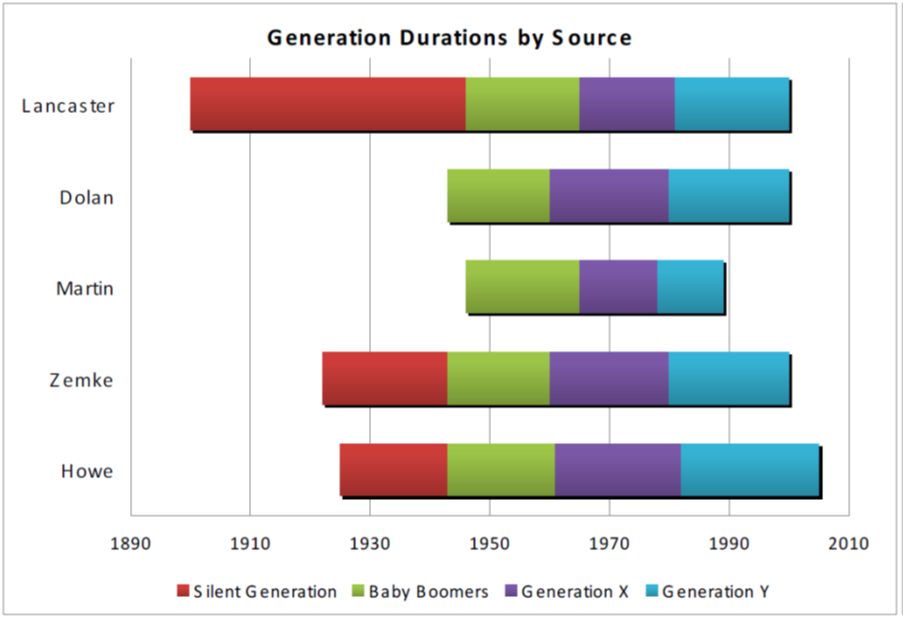
Figure 1: Generational Timings as per source. (Wallace 2007)
I would relate these differences to generational location and specific events related to those locations, for example in the Arab World a distinct generation called Nakba (calamity) Generation stemmed out relative to the Palestinian territories occupation by Israel in 1948 which led to a mass migration of Palestinian population from their home land as refugees into neighbouring countries as well as a number of wars between Israel and the neighbouring countries in the following period. The Nakba Generation is synonymous to the baby boomer generation in the west. Furthermore I’d conclude that Generation Y start dates for the Middle East might be delayed to start in the early 1990s as that would be the time where the region started to become exposed to technology as well as the globalization process. On the other hand, I believe that the differences between the members of generation Y in different localities are diminishing rapidly also as an effect of the spread of access to information technology and cross cultural interaction.
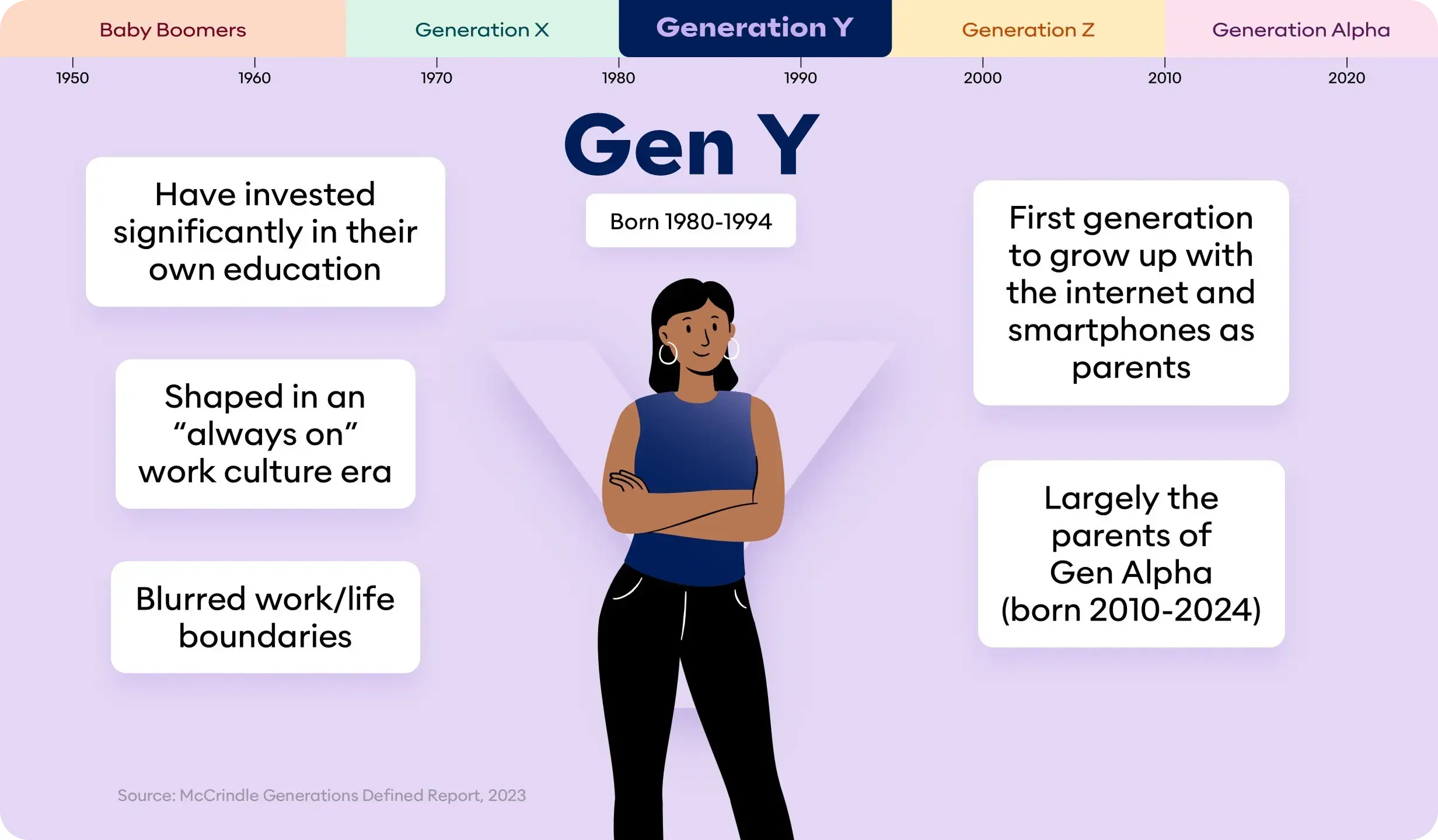
With Generation Y (which is also referred to as the millennial generation) in mind and going back to Howe and Strauss, Generation Y has been classified as having a Hero (Civic) archetype in an unravelling era that is characterised by culture wars, postmodernism and wide adoption of digital technology (for more information on archetypes and turnings please refer to Appendix B: Strauss and Howe Archetypes and Turnings). This classification implies that generation y came at a time where society mood is enjoyment and that the members of this generation grew up over protected, pragmatic, self-confident, team oriented, and social. Though I belong to the late members of generation x which to an extent brings me to the early members of generation Y, my personal experience with members of this generation makes me a bit uncomfortable; on one hand I see positive attributes with regards to character such as self-confidence, technological savvy and social interaction, but on the other hand I see negative attributes with regards to their attitude towards money, entitlement orientation, narcissism and lack of both responsibility and loyalty.
Generation Y Attributes
Upon reading material in preparation for this paper, I was surprised at the amount and diversity of research and articles on generation y. However, considering the generations’ sheer numbers and percentage of the world population, their coming of age to enter the workforce justifies the amount of research. So what does research tell us about generation Y?
The college age cohort of Generation Y is aware of social issues and is supportive of cause related initiatives (Keating 2000), Yerbury elaborates:
“Contemporary young people are described as having been born into an age where they are unable to rely on anything (Beck 2001), yet they have incorporated this uncertainty into their lives, with members of Generation Y exuding an optimism and sense of confidence not often found in members of Generation X. They are likely to be well travelled and to use information and communication technologies without a second thought about the implications of these activities for the sinking of distance and the compression of time. They are also less concerned with permanence in the workplace or in where they live. They exhibit a range of contradictory impulses, on the one hand valuing the opportunity to take the initiative and try radical, new ventures and, on the other hand, seeking conformity and security (Huntley 2006; McCrindle 2008). They tend to espouse a set of values that affect all aspects of their lives, choosing to make decisions about everyday life from a perspective of self-actualisation (Giddens 1991,p.214)” Yerbury 2010
The following table is taken from a Deloitte Consulting (2005): Who Are The Millennials, aka Generation Y?
| Table 2: Who are the millennials | ||
| Demographics | Tech-savvy | Millennials at work |
| No definitive agreement on birth years; experts say somewhere between 1978 and 1995; most say 1981 to 1993 | Connected…24/7 | Work well with friends and on teams |
| Self-confident | Collaborative, resourceful, innovative thinkers | |
| Optimistic | ||
| Children of Baby Boomers | Hopeful | Love a challenge |
| Independent | Seek to make a difference | |
| Comfortably self-reliant | Want to produce something worthwhile | |
| Younger siblings of Gen Xers | Determined | |
| Goal oriented | Desire to be a hero | |
Largest generation (75 million) after the Boomers (80 million) compared to the Gen Xers (40 million) | Success driven | Impatient |
| Lifestyle centred | Comfortable with speed and change | |
| Diverse | ||
38% of millennials identify themselves as “non-white” | Inclusive | Thrive on flexibility and space to explore |
Global, civic- and community-minded | Partner well with mentors | |
| Positioned in history to be the next “Hero generation” | Value guidance | |
Pulling together | Expect respect | |
I would agree with the above research findings and find them in line with Howe & Strauss’s research where it conforms to the Hero archetype: are born after an Awakening, during a time of individual pragmatism, self-reliance, and laissez faire. Heroes grow up as increasingly protected post-Awakening children, come of age as team-oriented young optimists during a Crisis, emerge as energetic, overly-confident mid-lifers, and age into politically powerful elders attacked by another Awakening. (Strauss & Howe 1997)
Having the above said coupled with the fact that generation y is 38% of the world population; millennials become an important segment from both employers perspective looking for fresh talent and from a customer perspective with a decent purchasing power “Of the $6.5 Trillion spent annually by consumers in the U.S. some $600 Billion is spent by the 80 million members of generation Y” (Gronbach 2000), what this means to me is that organisations have to work hard on understanding generation Y both to manage and sell to in addition to the underlying impact on organisational strategy, structure and culture.
Organisational Design
For the purpose of this paper, I’ll only be touching on the surface of organisational design principals where the purpose is to highlight and emphasise the human element, its effect on organisational design and the relation with Generation Y attributes.
Regardless of the nature of organisation, it needs to have a purpose; whether it is an NGO, a service, or a manufacturing organisation there are always organisational goals to be met. Mullens (2010: P542) states that “The overall function and direction of an organisation is determined by the nature of its corporate strategy. Strategy provides goals, objectives and guidelines for the structure and operations of the organisation”. What this means to me is that organisational design follows the corporate strategy, and thus there is no best way for organisational designs and each organisation can have its unique design features.
Another factor of the organisational design which I cannot separate from strategy is culture. Since organisations don’t operate independently from the environment which is part of, the pervasive nature of culture in terms of external influence and “how things are done around here”, values, beliefs and attitudes have significant impact on organisational structure design (Mullens, 2010, P552).
The below star model by Jay Galbraith for organisational design is the mostly used model for conceptualization of organisational design since the 1970 (Galbraith, 1995).
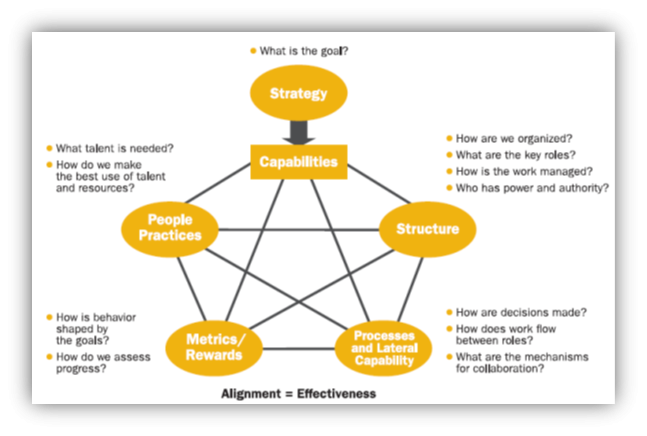
Figure 2: Star Model for organisational design conceptualization.
The star model clearly has “People Practices” as an integral factor the design of organisations and asks the designer two specific questions about people: What talent is needed? And do we make best use of talent and resources? To answer these questions; understanding the values and attributes of talent joining the work force becomes essentials while at the same time in line with today organisations such as the learning organisations, complexity approach, and virtual organisations. One of the interesting modern approaches to organisational design is the contingency approach which emphasises the need for flexibility; the main influences in the contingency are illustrated in figure 3 below (Mullen, 2010, P586-588). The model clearly identifies the characteristic of members of the organisation and organisational culture are considered main factors in the organisational design.
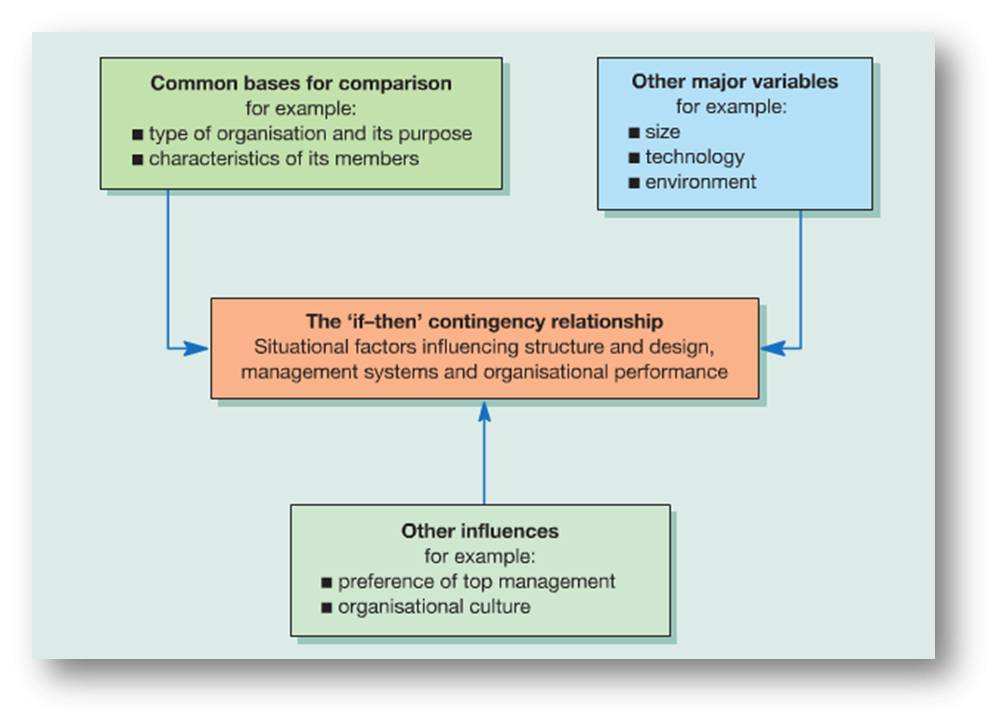
Figure 3: Main influences in the contingency approach to organisational structure design
Having established the relationship between culture, organisational members’ attributes and values with organisational design; what would the impact of generation Y entering the workforce as well as a large customer segment on today’s organisations and design?
Impact of Generation Y Values on Today’s Organisations Design
In the previous sections I’ve established that individuals’ attributes and characteristics have an impact on organisational design. However since organisations have different structures, strategies and cultures; that impact can be accommodated in a number of ways depending on organisation types and existing structures. Furthermore that impact can vary by department and job design but for the purpose of this paper I list generic implications to organisations:
Table 3: Generation Y Values and Attributes impact on organisations | ||
| Generation Y Attribute | Underlying requirement as employees | Underlying Requirement as customers |
| Cause Oriented | Need to believe that they are a part of an organisation that cares about society (Introduce CSR programs) | Willing to buy from an organisation that is perceived to care about the community. (Engage Cause Related Marketing) |
| Connected 24/7 | Provide mobile access to work environment | Offer e-Trade, web based support and web shops |
| Social, team oriented | Provide collaboration tools, Internal communities and websites. Encourage cross functional teams. | Offer products that can be shared or interactive with peers |
| Self-confident, independent | Provide work challenges related to a clear career path | Focus branding on uniqueness and carefully targeted product offering |
| Lifestyle Centric | Will require innovative pay structures | Branding becomes more important |
| Success Driven and Goal Oriented | Provide performance related rewards and promotions | Offer products that increase efficiency |
| Less concerned with permanence to work place | Offer international assignments, develop carefully designed employee retention programs | Increase spread and ease of product acquirement to different geographies (e-Channels) |
| Value Guidance and mentorship | Provide a coaching and mentorship management style | Provide opportunity for customers to learn something new from products |
| Thrive on flexibility and space to explore | Provide flexibility with regards to working space, location and knowledge access | Provide customized offering through multiple channels |
| Impatient | More dynamic approach to processes and change | Service and availability become critical factors |
A shift in design principals and success factors began to emerge at the end of the 20th century, this shift resonates well with the emergence of Generation Y. Table 4 summarises the older and newer factors of success with regards to organisational design (Ashkenas et al.,1995 p7):
Table 4: Old vs. New success factors for organizations | |
Old Success Factor | New Success Factor |
Size | Speed |
Role Clarity | Flexibility |
Specialization | Integration |
Control | Innovation |
One more thing to consider is that another impact of the emergence of Generation Y to organisational design has to do with existing Generation X and Baby Boomers presence, it is most likely that Generation Y employees would be supervised by a mixture of members of Generation X and late Baby Boomers; which means that if organisations are to adapt they’ll have to bridge gaps and different patterns among these generations.
Conclusion
There is no doubt that Generation Y entry to the workforce and customer base has a direct impact on organisational design. The attributes of Generation Y need to be accommodated if organisations are to capitalise on this segment that has a huge potential. Like everything in life there are Pros and Cons for everything, Generation Y attributes can provide opportunities for cost reduction, increased agility in approach to business,…etc. while on the other hand Generation Y affinity travel and lifestyle centricity makes them high maintenance individuals.
Though information technology spread and rapid adoption throughout the world is decreasing gaps between Generation Y members in different parts of the world; still locality, exposure and social culture are variables to be considered when designing organisations. One thing for certain is since organisational settings are influenced by psychology, sociology and economics we can safely say that it is never a laboratory controlled environment and that findings are constantly changing depending on situations and events. We can only plan to accommodate change, train ourselves to become more agile and flexible to capitalize on opportunities as they unfold.